Let’s clear up some confusion. Large language models (LLMs) are not sentient beings, though we often paint them such in popular culture. The reality, while less futuristic, is no less intriguing. These models are, in essence, expansive pattern-matching apparatuses, decoding and predicting text at a sprawling scale.
Their learning mechanism resembles more a masterful game of connect-the-dots than the quintessential ‘genius machine’ often imagined. Intrigued by their apparent intelligence? Stick around as we peel back the layers, revealing the understated elegance powering such seemingly intelligent constructs.
Foundations of Large Language Models: Data, Architecture, and Training
Leaping headfirst into the complex sea of AI may seem daunting! But at the base level, all language models, even the massive ones, consist of three pivotal components – data, architecture, and training. Let’s sketch out a rudimentary picture.
Data, heaps and bounds of it, serves as the backbone of these models. They chew on gigabytes of text and spit out predictions, learning the nuiseness of language in the process. The architecture, on the other hand, provides the blueprint or the structure these models follow. Transformer architecture is prominent here and will be our focus later on.
Lastly, we arrive at training – a rigorous repeat of feed, adjust, repeat, until these models have a firm grasp of the data they’re dealing with. The scale and intensity of training is what truly sets LLMs apart.
Grasping these three pillars of LLM is like holding the world – it’s foundational to understanding how these seemingly complex systems operate. Operate they do, on a grand scale, driven by the simple mechanism of learning from decillions of data points.
An Inside Look: Text Breakdown & Numerical Conversion
Let’s take a step inside this AI world. The first task at hand, Tokenization, involves chopping up a paragraph, much like a chef precisely dices an onion. Slices could be words, subwords or even characters depending upon the technique used.
We then move on to the intriguing part of numerical representation. It’s not rocket science really, just a smart technique. These sliced-up units called tokens are given numerical identities, known as vectors.
Enter, Embeddings. This nerdy term merely represents these vectors in a denser format. The beauty of embeddings is that they can capture the essence and relationships between words within this high-dimensional mathematical space of ours. And get this – similar words cluster together in this space, possessing similar vectors.
Now, isn’t that an engaging way to imagine how an AI model deals with raw text? This is just the tip of the iceberg. Ahead is the vast sea of AI exploration waiting to be discovered.
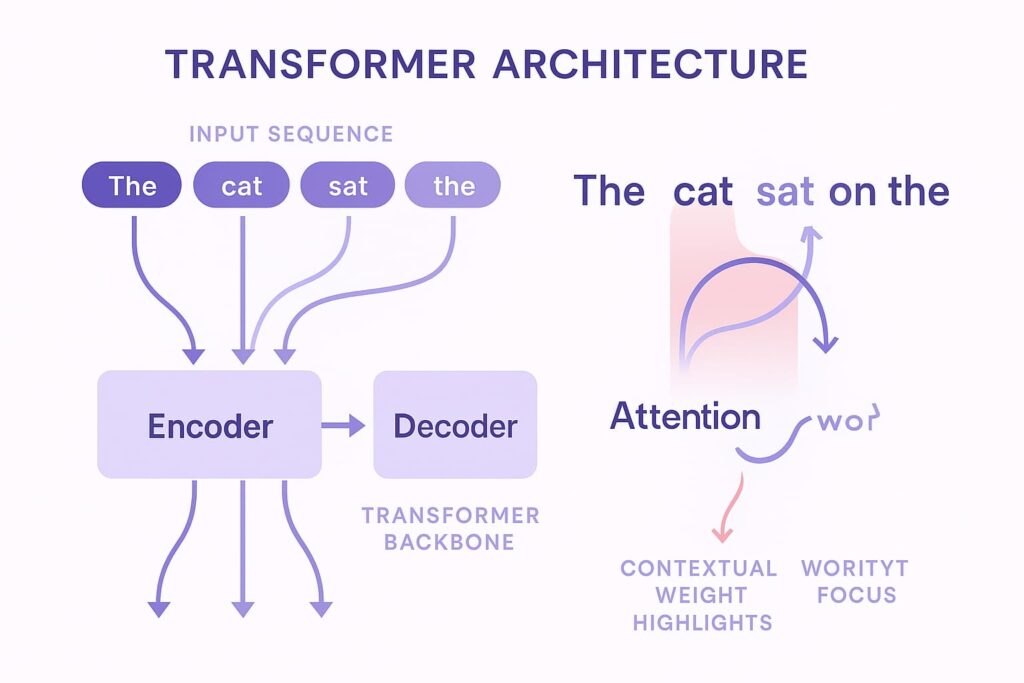
Transformer Magic: The Power of Attention
Ever tried playing a game of telephone? You whisper a sentence into your friend’s ear, they whisper it to the next person, and so forth. By the end of the line, the sentence often morphs into something hilariously unrecognizable. Previous neural network models behaved similarly. They’d lose parts of sentences while retaining only the most recent information, like those whispering kids in our game.
That’s when Transformers, the stars of our current AI universe, stepped in to break this chain. Their magic trick? The ‘Attention Mechanism’. In contrast with the one-way game of telephone, imagine a circular table where everyone’s connected, everyone’s listening to not just one, but all whispering voices.
This mechanism allows a model to allocate variable attention to different words while processing a sentence. While paying heed to a specific word, it draws not only from that word’s immediate neighbors, but from the entire context.
Like a student studying a tough chapter, giving extra attention to complex concepts while skimming simpler ones. It may sound fascinatingly complex, but this ‘attention’ technique is a breakthrough that has revolutionized how models understand and generate language.
Even within our conversation on AI, this paragraph, for instance, could be better understood by the transformer model giving varied attention to phrases like “game of telephone”, “circular table whispers”, and “student studying a tough chapter”. Feel intrigued? Let’s dive deeper into this AI wonderland!
Unraveling the Layers: Pre-training and Fine-tuning
When it comes to understanding the working mechanics of large language models (LLMs), there’s a common myth floating around that they’re ‘programmed’ with knowledge. In reality, it’s less about ‘programming’ and more about ‘learning’. So, let’s put on our learning caps and get to the heart of the matter.
The magic all starts with Pre-training. Picture this process as a resourceful detective solving a mystery on his own. Our model, the detective, becomes well-versed in deducing the meaning of words by predicting what could fill in a missing gap or guess the next word in a sentence within an enormous text corpus. The scale of this prediction escapade is simply mind-boggling; imagine solving thousands of puzzling crosswords in every language known to mankind!
Entering the next phase, we come across Fine-tuning. This part is like our detective getting specialized training for a specific case. They take the broad knowledge gained during pre-training and then adapt it to handle carefully chosen tasks such as sentiment analysis or text summarization. This phase relies on labeled data, which guides the model like a laser-targeted compass, orienting it towards increased precision and specialization.
Grasping these multi-layered learning strategies gives us an insight into why AI language capabilities are continuously on the rise. Remember, it’s not just about coding knowledge into these models, but about fostering a learning environment where they can grow, adapt, and excel on their own.
Pen to Paper: The Creativity of Language Models
The art of language generation by large language models (LLMs), is a chronicle of inferences. Picture the model as an author, every stroke of their pen governed primarily by a technique named Probabilistic Prediction. The author, armed with the nuances learned from a vast corpus of text, hypothesizes the most likely next word – or ‘token’ – based on the preceding words.
Did you think it’s a simple case of mechanical predictability? On the contrary! Language models apply Sampling Strategies to shake things up. Strategies range from ‘greedy decoding,’ which invariably picks the most likely subsequent token, to ‘beam search’ and ‘top-k/top-p’ sampling adding a wild streak, thus introducing an element of surprise in the output.
Finally, the model employs a process of Iterative Generation. Imagine writing a letter; you pen down one word at a time, each new word influenced by those preceding it. The model does something similar, generating language piece by piece, each new prediction flavored by the model’s previous choices. This intricate interplay of learned patterns, strategic predictions, and creative sampling is what gives LLMs their human-like knack for language.
“Eloquent simplicity,” isn’t it?
Between Promise and Pitfalls: AI Language Models in Action
What if you could summon words to pour onto a blank page and watch as they form quality content, engage with a virtual assistant that knows exactly what to say to your customers, or allow a clever algorithm to scour your data, pulling out deep insights?
On the flip side, imagine grappling with biased results, combating the virality of misinformation, or foot the massive computational bill. These are the contrasting worlds where AI language models exist.
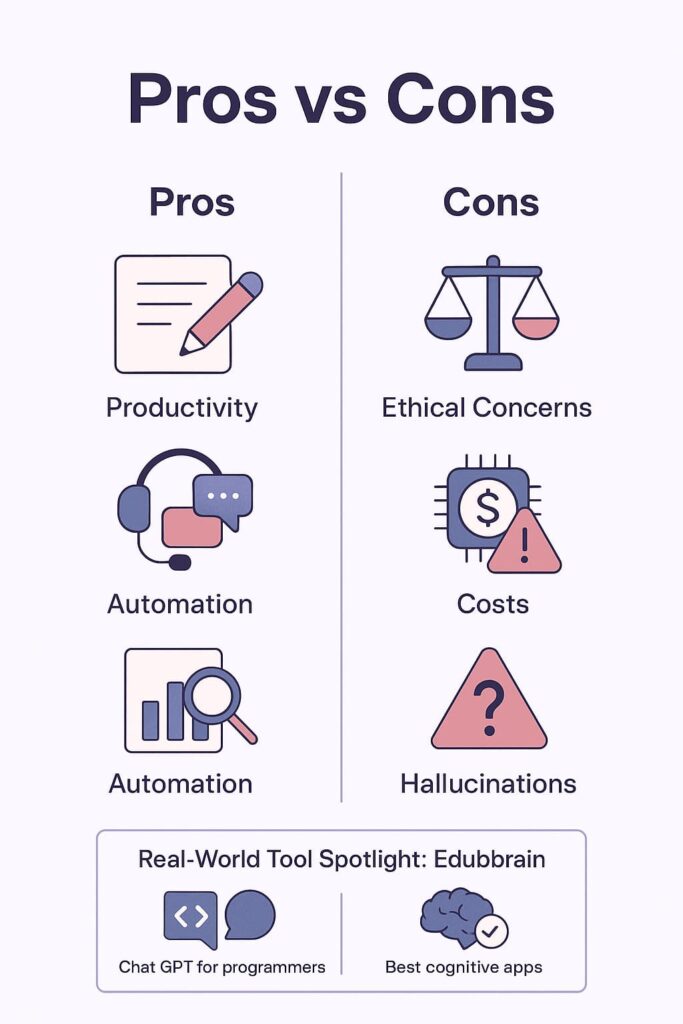
One may argue that the benefits outweigh the challenges; increased productivity in generating content, spruced up customer service, high-level data analysis, and rapid prototyping spell out noticeable advantages.
Dive into something like Edubrain, a multifaceted platform, and you’ll see AI’s apron strings tied to an array of everyday tasks. This paints a vivid picture of why developers should grasp how these models function—it’s about constructing sturdier and more effective AI applications, such as specialized Chat GPT for programmers.
Yet, the drawbacks are equally real and significant. Ethical dilemmas associated with bias and misinformation are immense. Resources, too, get stretched thin due to the computational cost involved. Language models, for all their elaborate training, exhibit a worrying lack of true understanding and sometimes produce startling ‘hallucinations’.
For those enticed by the allure of enhancement, exploring leading cognitive apps can yield substantial gains, covering everything from learning intricate subjects to nailing down common Italian phrases for travel. As always, the first step in manipulating the power held by AI language models effectively is understanding precisely how they work.
Charting the Course: What Lies Beyond Today’s AI Language Models
Our journey through the intricate workings of AI language models leads us to an enticing crossroads. Down one path, ongoing explorations are revealing the potential of multimodal AI. It’s this blend of vision and language processing that promises an AI capable of deeper understanding and interaction with the world.
Another route awaits the champions of efficiency. Researchers strive to streamline language models, trimming their vast networks to fit into smaller, more pocket-friendlier versions that still pack a potent punch. Yet, this technical prowess must not eclipse the importance of ethical considerations.
Comprehension of AI’s neural intricacies isn’t merely a quest for power or optimization; it serves as a compass for wise navigation. Trade-offs exist between transparency, fairness, and the effective implementation of these technologies. Bias detection, just one among these considerations, carries immense weight, mirroring the pervasive global demand for equitable AI treatment.
In this complex territory of rapidly advancing AI utilization, acquiring a solid grasp of ‘how’ these models operate is a preliminary yet crucial step. The understanding gained here acts as an anchor to the question of ‘should’, tackling the ethical implications tied to AI use.
This consciousness is vital for those navigating the future of AI – a future laden with promise, yet demanding of careful stewardship. After all, understanding the technology’s construction underpins the decision on how to deploy it responsibly.
AI language models, as we’ve explored, are a current marvel. Their inherent complexity, impressive capabilities, and potential shortfalls alluringly plight us to dive deeper, to not just blindly utilise but also responsibly master these technological wonders of our age.
The Crucial Bits: Understand to Harness AI Better
Deep dive into AI Language Models (LLMs) reveals they are indeed intricate pattern identifiers, making sense of language through a combination of tokenization and embeddings. At their core lies the transformative architecture and attention mechanisms, foundational pillars for their proper functioning.
These models don’t just pop into existence – they evolve through rigorous pre-training and fine-tuning steps, meticulously programmed to spew out text based on probability. The major takeaway, you ask? To wield AI’s capabilities effectively and responsibly, peeling back its layers for a deeper comprehension is not an option, but a necessity.
The Odyssey Unfolds: Be a Part of AI’s Evolution
Your exploration of large language models (LLMs) hasn’t been in vain. Each step has taken you beyond the mysterious facade of AI, and closer to a nuanced understanding of its inner workings. With this newfound knowledge, you’re poised not just to harness, but to contribute to the development of AI.
There’s a brave world of open-source models waiting for your exploration. Diving headfirst into these accessible resources, you’ll find opportunities to sharpen your AI skills further. Don’t stop here, you’re just getting started.
Let’s mull over a compelling vision – a future where humans and AI collaborate seamlessly. Your role isn’t just limited to learning and applying AI tools. As the technology evolves, so will your understanding, preparing you to play an active role in steering the future of AI. Now, isn’t that a thrilling prospect?