We often talk about artificial intelligence, AI, for short, as if it speaks our language. We attribute human traits to it and expect it to understand our world exactly like we do. Yet, this common perception is misleading. AI does not ‘learn’ or ‘communicate’ in the same way humans do.
Its operational ‘language’ is rather a maze of machine learning algorithms and neural networks. Businesses that fail to recognize this discrepancy may unknowingly limit AI’s potential or overestimate its capabilities. This article aims to challenge this anthropomorphic idea and to provide clarity on the intricate ‘languages’ of AI in business landscapes.
Quantifying Qualitative Data: AI’s Language Bridge
Picturing AI as a multilingual entity, flawlessly toggling between human languages, strikes one with awe but fosters a misunderstanding. This bridges to the truth: AI does not ‘speak’ English or Spanish, rather it operates in a profoundly mathematical and statistical realm. Such human languages are predominantly used as a communication interface for both inputs and outputs.
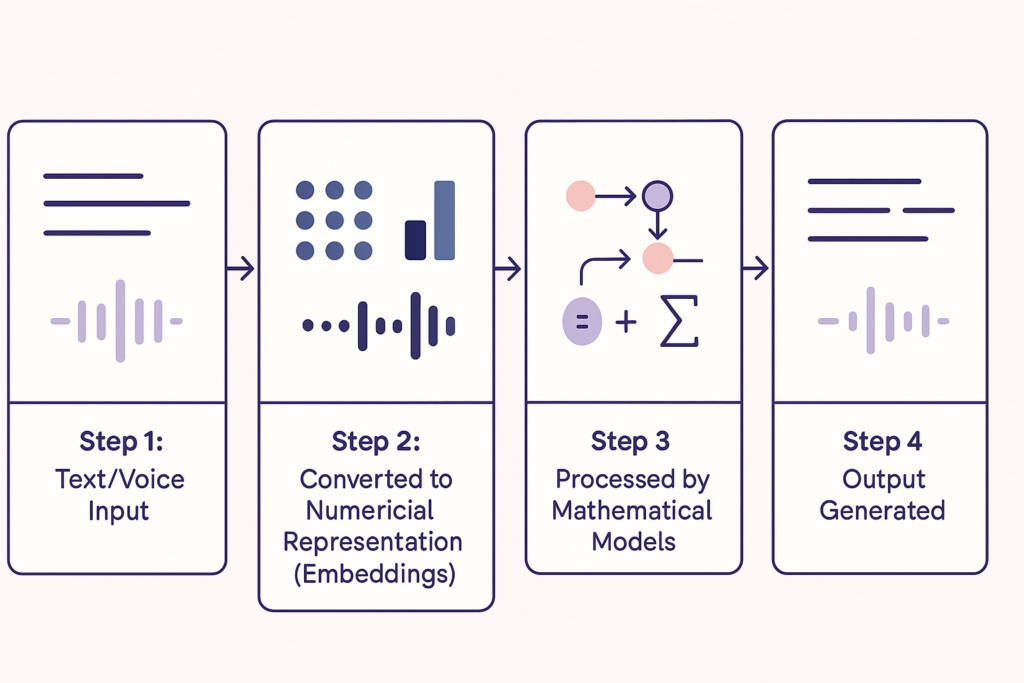
What does this transformation from human-readable data to machine-readable data look like? Envision a complex process christened Natural Language Processing (NLP) that ingeniously encodes qualitative data (our words, sentences, and documents) into numerical representations. These numerical entities, often referred to as embeddings or vectors, then become the raw material the machine can grasp and manipulate.
For AI, this language metamorphosis takes human language, a description of experiences, and converts it to digits and equations , the stuff of AI dreams. Simply put, it changes the ‘human’ qualitative information into the ‘machine’ quantitative data.
Hence, aiding businesses to unlock yet unexplored dimensions of their AI strategy by making sense of this intricate process. Notably, bigger strides are on the horizon in AI language literacy, with implications far beyond the world of business.
AI’s Operating Principles: The Real ‘Chat’
You might think of AI as a babbler, ceaselessly chatting in a complex stream of binary code. Yet, the truth pulls us into a more intricate reality: Four distinct ‘languages’, or operational principles, form the bedrock of AI’s communication:
- Probability and Statistics: Just like humans consider probability in decision making (ever checked the forecast before a picnic?), so does AI make choices based on patterns and likelihoods.
- Linear Algebra and Calculus: AI’s brain, also known as neural networks, relies heavily on these two mathematical fields. They help the machine transform and interpret data for it to make sense of the world.
- Graph Theory: In the world of AI, this field helps it understand relationships within data, mapping patterns, and building networks. You can visualize it as AI’s version of social networking!
- Binary Code: The ultimate ‘lingua franca’ for all computers, including AI. It’s the bedrock of all AI processes, turning intricate operational principles into executable commands.
So next time you imagine AI communicating, envision not a simple chatterbox, but a language virtuoso, playing a symphony on the keyboard of these four principles.
AI Myths Debunked: What It Really Understands and Creates
Artificial Intelligence seems magical, doesn’t it? Yet, it is often misunderstood. Let’s navigate through some popular misconceptions about its capabilities and provide a counterpoint rooted in reality.
Untouched is the myth that AI comprehends meaning and context just as we do. In reality, its process involves identifying patterns and correlations lurking within data. Consequently, AI drums out responses based on predictive models. It lacks the consciousness necessary for human-like comprehension.
Shedding light on another misconception: AI isn’t a language scholar ‘learning’ new tongues as humans do. It merely trains on voluminous datasets of pre-existing languages. This identification of statistical relationships helps it generate coherent responses but remember, its ‘learning’ lacks human-intention or intuition.
Moreover, there’s a belief circulating that AI can produce truly original content. Rather intriguing! But wait, the truth unfolds differently. AI’s innovation boils down to a sophisticated form of pattern matching and prediction. It generates appealing yet novel combinations of existing information.
Let’s remember – the language of AI is rooted in mathematical principles and statistical correlations, not human cognition. Recognizing this distinction is crucial in harnessing AI for business intelligence and ethical applications.
Dipping Into the Data: Business Implications of Decoding AI’s Real ‘Language’
It’s time to dig into the real meat of this matter. What does your business stand to gain from pulling the curtains back and understanding the mechanisms by which AI operates? Quite a lot, as it turns out. Certainly, it’s not merely an intellectual exercise. Acknowledging that AI functions on data and algorithms instead of human intuition paves the way for a broad spectrum of practical implications.
Firstly, it enables business leaders to set a balanced trajectory for AI projects. Knowing AI’s limitations and strengths means no more shooting in the dark but making educated decisions — an end to overly ambitious projects doomed to disappoint and a thoughtful focus on realistic targets.
A new lens is also provided for viewing data through. Language’s nuances and metaphors have no place here, only data does. Leaders armed with this perspective can propel their businesses to build more effective data strategies.
Shining clear light on AI’s operations also brushes off dust from ethical concerns. These insights equip us to discern the potential pitfalls and risks involved with automated decision-making, thereby promoting ethically solid business practices.
The final cherry on top? Tailored solutions. With all the chatter about general intelligence cast aside, businesses can hone AI as a tool purpose-built to tackle specific challenges. Instead of a swiss army knife, picture a precision tool shaped just for your unique problem.
Lifting the veil on AI’s true ‘language’ untangles misconceptions, providing a fresh approach to AI integration. It’s high time we stripped this ‘mystical entity’ down to its basics and used it to boost our businesses, ethically and efficiently. And remember, the key to this revolution rests not in a secret incantation but in comprehending the simple mantra: data and algorithms.
Making Sense of AI for Real Business Impact
1. Embrace the data-centric nature of AI: Your focus, right from the get-go, should be on clean, structured, and relevant data. It stands as the pillar supporting your AI initiatives.
2. Get selective with your algorithms: Some business questions call for predictive algorithms while others may require generative ones. The key is to kick start with a clear understanding of your business problems and then guide your choice of algorithm accordingly.
3. Weave in human oversight: It’s essential to design workflows that include human intervention, validating your AI outputs. AI makes sense when humans make sense of it.
4. Incorporate ethical guidelines: Proceed towards AI incorporation only when you’ve chalked out clear-cut guidelines that address potential biases in data and questions of algorithmic fairness. Don’t let ethics be an afterthought in your AI strategy.
These steps, when followed in tandem, can efficiently bridge the gap between AI language and actionable business intelligence. And the thing to remember? Decoding AI isn’t about learning a new language, it’s about understanding how it operates underneath, breaking free from unfounded assumptions, and leveraging its innate strengths to drive business success.
Tools for Unraveling AI’s Mysteries
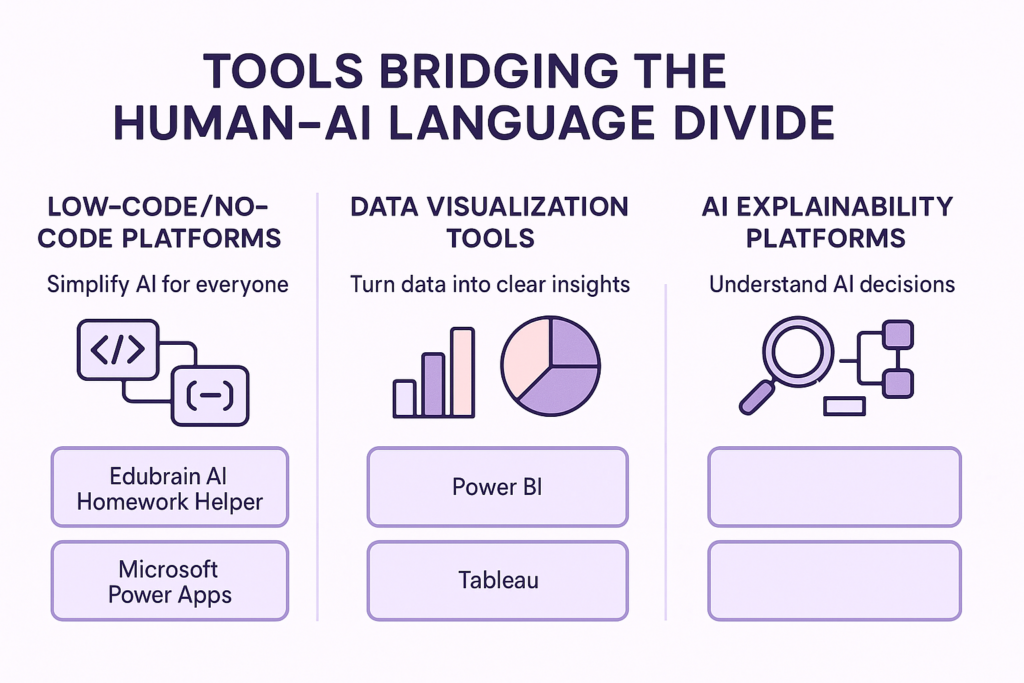
In the world of virtual interaction, we rely on some intermediaries to truly comprehend what language does AI speak. These bridges from human to machine aren’t high-tech Rosetta Stones, but rather straightforward tools and platforms that allow us to scratch beneath the surface of complex machine learning algorithms.
First in line are Low-Code/No-Code AI Platforms, championing the cause of democratic AI access. Their simplicity invites even the most tech-averse among us to grapple with AI’s nuts and bolts.
Next up, we encounter Data Visualization Tools, visual magicians that morph intricate AI outputs into understandable and engaging graphs, charts, and plots. They equip us to navigate the dense maze of neural networks.
Our tour wouldn’t be complete without the AI Explainability (XAI) Platforms, aids that help us decipher why an AI agent made a particular decision. They treat us to a rare peek into the AI mind, offering transparency in an otherwise opaque system.
Similarly, Edubrain plays a key role in this sphere, enabling users to make sense of complex AI-driven tasks. It’s more than just an AI homework helper. It’s a translator, turning raw computational outputs into digestible, actionable insights, tailor-made for applications like learning. Through these tools and platforms, AI’s real ‘language’ becomes a less cryptic, more accessible script for business intelligence.
AI’s Ongoing Evolution: Coded, Not Conscious
As we gaze into the future of artificial intelligence, it’s critical not to mistake pattern recognition for consciousness or comprehension. Sure, the capability of AI to parse and yield human-like texts will advance, but its core ‘language’ stays grounded in the realm of mathematics and statistics. It’s about crunching numbers, not understanding the nuances of human conversation or the complexity of our emotions.
Remember, AI is as sophisticated as it may get, it doesn’t truly comprehend in the way humans do. It identifies patterns, replicates, and applies, driven by a set of predefined rules and procedures, not a consciousness. This distinction is the crux, influencing our interactions and framing our continued evolution with AI. In this way, the dialogue we have with AI will always be fundamentally different from the conversations we share with each other.
Deciphering AI: Essential Insights for Your Business
- AI doesn’t decipher human speech; it processes data and algorithms.
- Assigning human attributes to AI may lead to strategic miscalculations.
- Apprehending the actual operational ‘language’ of AI paves the way to effective implementation.
- The success of AI incorporation primarily hinges on data quality and upholding ethical norms.